


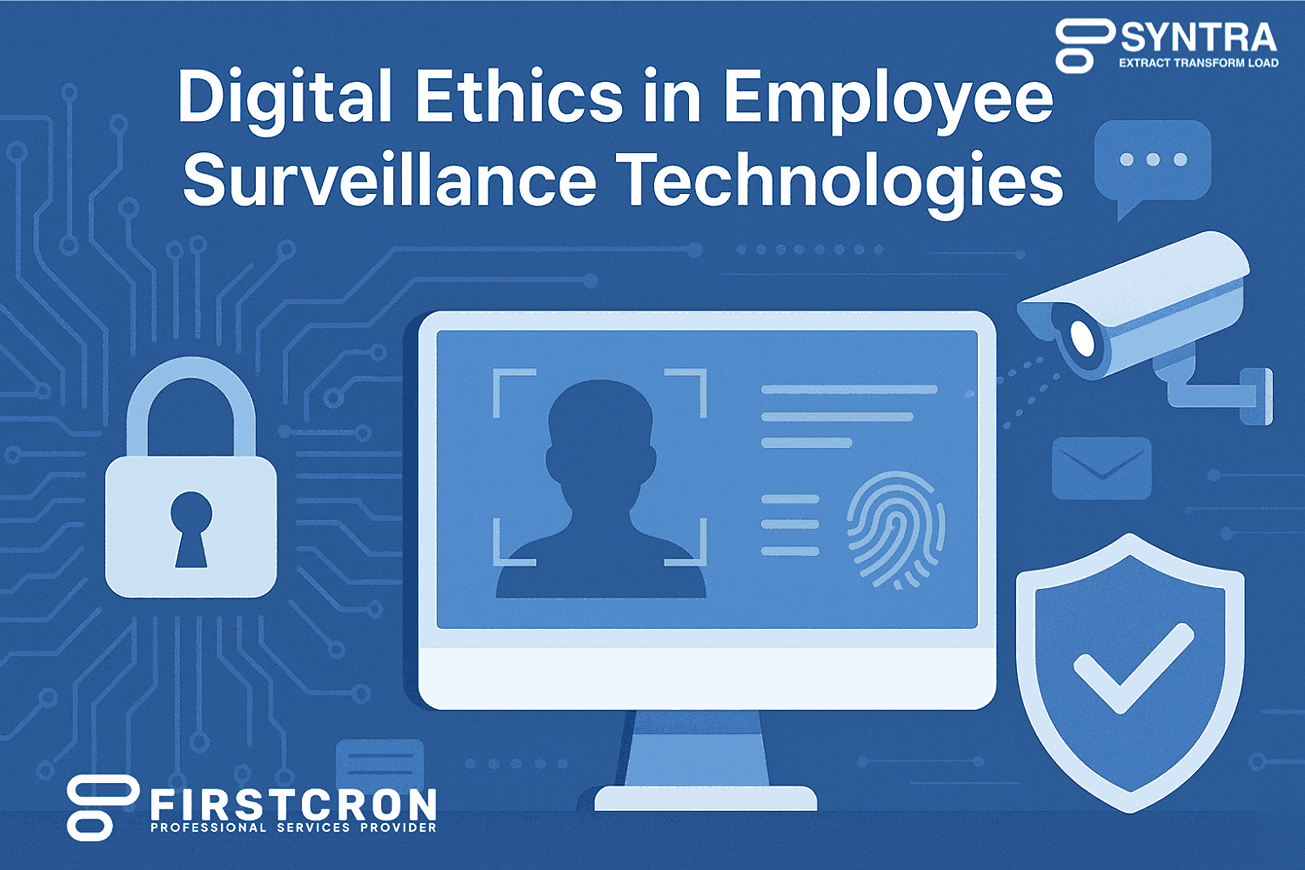
In the modern digital workplace, surveillance technologies have become increasingly common as organizations strive to enhance productivity, data security, and compliance. From activity trackers to AI-based behavioral analysis, these tools provide valuable insights into employee performance, especially within remote or hybrid work environments.However, with this power comes a profound ethical responsibility. The same systems designed to optimize workflows can easily cross into invasive monitoring, threatening privacy and eroding trust if not governed properly. Digital ethics in employee surveillance is no longer optional — it’s essential to building a culture of transparency and respect.
In this blog we’ll cover
The Ethical Dilemma: Efficiency Vs. Privacy
Employee surveillance often walks a fine line between operational necessity and personal intrusion. While companies may argue that monitoring helps ensure accountability and security, employees often perceive it as a breach of autonomy and privacy.
Key ethical concerns arise when organizations collect more data than necessary or fail to communicate clearly about monitoring practices. Questions of consent, proportionality, and data ownership come to the forefront. A surveillance policy that focuses purely on control risks undermining morale and long-term engagement — replacing trust with fear.
Responsible Use Of Technology
A strong ethical foundation starts with intent. Organizations must clearly define why they are using monitoring tools and what outcomes they hope to achieve. Surveillance should serve legitimate business interests such as data protection, workflow optimization, or compliance — not as a means of micromanagement.
To implement this responsibly, companies must ensure:
- Transparency: Employees should know what data is being collected and how it will be used.
- Consent: Data collection should occur with clear communication and agreement.
- Proportionality: Monitoring should be limited to necessary metrics without overreach.
When employees understand the purpose and boundaries of surveillance, they are more likely to perceive it as a tool for safety and improvement rather than intrusion.
Syntra And Data Governance In Ethical Surveillance
Managing employee monitoring ethically requires more than good intentions — it demands strong data governance and technical safeguards. This is where platforms like Syntra (syntra.firstcron.com) play a crucial role.
Syntra, an advanced ETL (Extract, Transform, Load) tool by FirstCron, allows organizations to manage and integrate monitoring data responsibly. Through automated extraction, transformation, and controlled data loading, Syntra ensures that employee information remains secure and compliant with privacy laws such as GDPR and CCPA.
With built-in access control, encryption, and audit trails, Syntra empowers companies to use analytics without compromising ethics. It helps transform raw monitoring data into actionable insights while preserving transparency and accountability — reinforcing that technology can serve both efficiency and empathy.
Building A Framework Of Digital Ethics
To maintain ethical equilibrium, organizations should adopt a Digital Ethics Framework that governs how surveillance data is collected, analyzed, and applied.
Such a framework typically includes:
- Policy Clarity: Defining what types of monitoring are allowed and why.
- Data Minimization: Collecting only what is necessary for defined purposes.
- Anonymization: Removing identifiable information where possible to protect privacy.
- Fair Use: Ensuring data insights are used for improvement, not punishment.
- Accountability: Establishing oversight teams or committees to monitor compliance.
Embedding ethics into technology strategy ensures that employee surveillance aligns with organizational values and human rights principles.
The Human Factor: Trust And Transparency
Ethical surveillance is as much about people as it is about processes. When employees feel they are being watched without context, trust diminishes. Conversely, when organizations are transparent about their intentions, employees often become partners in maintaining accountability.
Effective communication is key. HR and IT departments should collaborate to educate teams about how and why monitoring tools are used. Sharing insights on how data contributes to improved safety, productivity, or collaboration builds credibility and reassurance.
Trust-based monitoring creates an environment where data collection supports mutual growth rather than fostering fear.
The Future Of Ethical Monitoring
As AI and automation continue to advance, the scope of surveillance will expand — from facial recognition to predictive behavior analytics. This makes digital ethics even more critical. Future systems must be designed with privacy-by-default principles, ensuring fairness and accountability at every level.
Technologies like Syntra will become essential to integrating AI-powered monitoring within ethical boundaries — enabling organizations to harness the benefits of analytics while protecting employee rights. The future of work will depend not only on digital capability but also on the moral intelligence guiding it.
Conclusion: Balancing Insight And Integrity
Employee surveillance technologies are powerful tools — but their ethical impact depends entirely on how they’re used. Organizations must shift from a mindset of control to one of collaboration and care.
By embracing transparency, setting clear ethical standards, and leveraging secure data platforms like Syntra, businesses can turn monitoring from a potential threat into a source of empowerment.
In the end, digital ethics isn’t about restricting technology — it’s about ensuring that progress respects people. A workplace grounded in fairness, trust, and respect is not only more ethical but also more productive and resilient in the digital age.
Tags
Related Post
Navigating Oracle Fusion HCM & Payroll Patch 25C: Key Issues And Solutions For UK Local Councils
July 26th, 2025 10 min read
Learning And Talent Management With Cornerstone OnDemand
October 10th, 2025 17 min read
7 Proven Oracle Fusion Testing Principles To Guarantee Defect-Free Cloud Deployments
May 16th, 2025 15 min read
7 Reasons Why Companies Are Moving From Taleo To Oracle Recruiting Cloud
June 2nd, 2025 14 min read
Navigating Oracle Fusion HCM & Payroll Patch 25A: Key Considerations For UK Local Councils
July 27th, 2025 10 min read
WEEKEND READS
Learning And Talent Management With Cornerstone OnDemand
October 10th, 2025 17 min read
7 Proven Oracle Fusion Testing Principles To Guarantee Defect-Free Cloud Deployments
May 16th, 2025 15 min read
UKG (Ultimate/Kronos) — USA And Global, Legacy-to-Modern Workforce Management
October 5th, 2025 23 min read
Driving Compliance And Security With Smart Testing In Oracle Fusion
June 5th, 2025 9 min read
How End-to-End Testing Of Oracle Fusion Enhances Operational Efficiency In Banking
May 23rd, 2025 11 min read

Smart Onboarding Journeys With AI: Personalized Employee Integration Through Oracle HCM Core And Learning
September 13th, 2025 21 min read
Smart Reporting In Oracle HCM: Use Natural Language To Build OTBI Queries
August 17th, 2025 20 min read
Your HR Assistant On Autopilot: Use GenAI To Power Oracle HCM Chatbots.
August 22nd, 2025 15 min read
Voice-to-Action In Oracle HCM: Transforming HR Queries Into Intelligent Actions With GenAI
September 5th, 2025 23 min read