


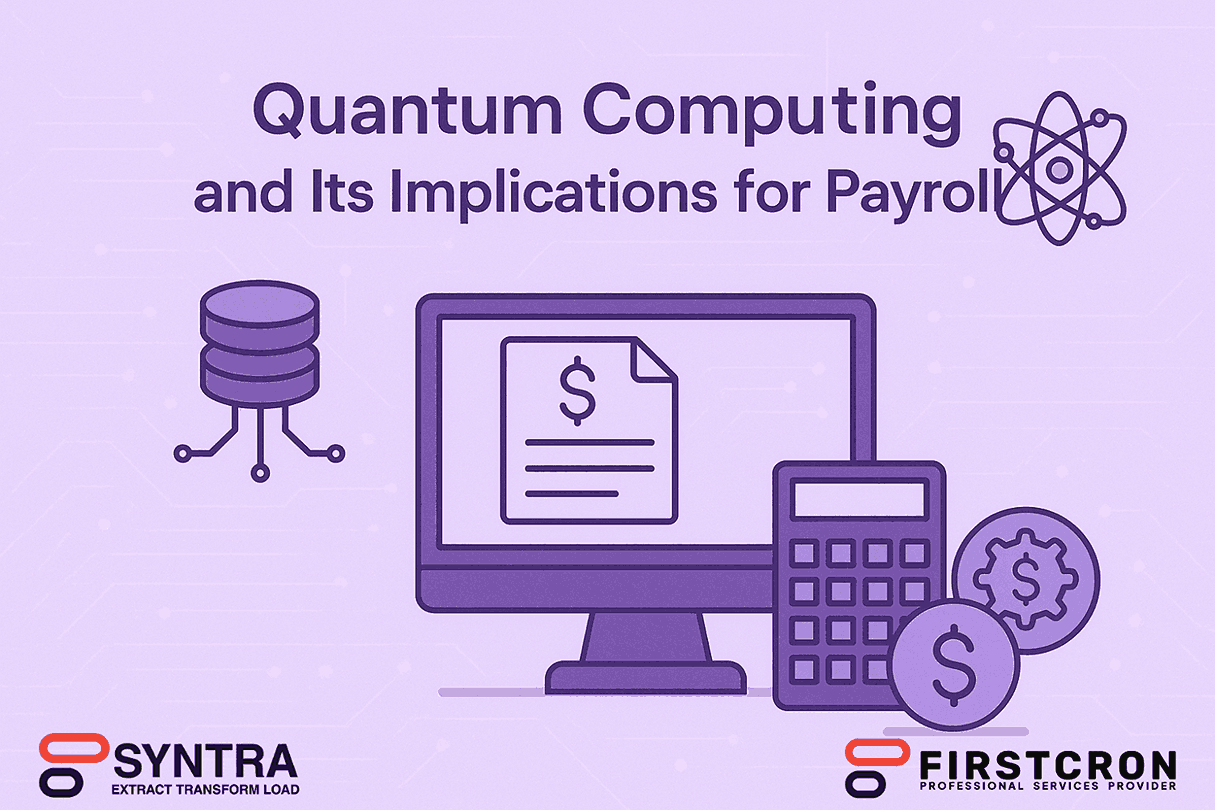
Quantum computing is particularly promising for optimization tasks. In the future, quantum-inspired or quantum-accelerated solvers could help organizations explore millions of possible configurations for things like shift rosters, global equity distributions, or cross-border assignment structures, and identify those that minimize cost while staying compliant.
In this blog we’ll cover
- Quantum Computing
- What Quantum Computing Actually Changes
- Security: Post-Quantum Payroll Data Protection
- Optimization: Tackling Complex Payroll Scenarios
- Advanced Analytics: Scenario Planning At A New Scale
- Syntra As The Quantum-Ready Data Spine
- Practical Steps: Preparing Payroll For A Quantum-Influenced Future
- A Quiet Revolution Behind The Payslip
Quantum Computing
Quantum computing sounds like something that belongs in physics labs and sci-fi movies, not in the world of payroll calendars and statutory reports. But as the technology slowly moves from theory to early commercial reality, it will eventually touch every domain that depends on heavy computation, encryption, and optimization. Payroll sits right in that intersection.
For organizations running complex operations across multiple countries, payroll is already a high-stakes data and math problem: millions of calculations, thousands of rules, endless combinations of tax regimes and benefits. Quantum computing will not replace existing payroll engines in the near term, but it will begin to shape the way we secure payroll data, optimize payroll processes, and design the integration layers that feed and consume payroll information.
In that emerging landscape, platforms like Syntra will play a critical role as the governed data backbone that connects traditional systems with more advanced analytics and, eventually, quantum-enabled services.
What Quantum Computing Actually Changes
Classical computers work with bits that are either 0 or 1. Quantum computers use qubits, which can exist in a superposition—essentially representing many states at once—while also becoming entangled with other qubits. This allows certain types of problems, especially those involving massive combinations or simulations, to be solved dramatically faster than on classical machines.
For payroll, that doesn’t mean re-writing every paycheck formula in quantum code. Most day-to-day calculations, from gross-to-net to overtime, are handled perfectly well by current systems. The implications show up in three broader areas: security, optimization, and analytics. Each of these depends on high-quality, well-structured data, which is where Syntra’s ETL layer becomes foundational.
Security: Post-Quantum Payroll Data Protection
One of the most discussed impacts of quantum computing is its potential to break widely used encryption algorithms. Payroll data is among the most sensitive information an organization holds: salaries, bank details, tax identifiers, and often health-related deductions. Much of this data is protected today using algorithms that could eventually be vulnerable to powerful quantum machines.
This does not create an overnight crisis, but it does start the clock on post-quantum security planning. Payroll platforms, integration hubs, and data lakes will need to migrate to quantum-resistant encryption standards over the coming years.
Syntra’s role here is twofold. First, it acts as a central place where data in motion is already governed—extracted from sources such as ADP or Oracle Fusion, transformed, and loaded into target systems. As organizations adopt post-quantum encryption, Syntra becomes the layer where consistent security standards can be applied across all those flows instead of retrofitting dozens of point-to-point connections. Second, its clear mapping and lineage make it easier to identify every touchpoint where payroll data is stored or transmitted, which is essential when upgrading security protocols.
Optimization: Tackling Complex Payroll Scenarios
Payroll in large enterprises is not just computation; it is also optimization. Think about assigning employees to cost centers, scheduling shifts under complex union rules, or choosing tax-efficient benefit combinations across jurisdictions. These problems can quickly become combinatorial, with a search space too large for brute-force approaches.nnTo do that effectively, these solvers will need accurate, up-to-date inputs: employee attributes, contract details, calendars, tax and benefit rules, and historical patterns.
Syntra is the bridge that supplies that data in a standardized form, regardless of whether it originates in payroll, HCM, time, or finance systems. It can also capture the optimized outputs—new schedules, costing allocations, or assignment plans—and load them back into operational systems without manual re-keying.
The result is not “quantum payroll software” replacing everything you have, but quantum-enhanced optimization services working alongside your existing engines, fed and stabilized by Syntra’s integration layer.
Advanced Analytics: Scenario Planning At A New Scale
Payroll data is a treasure trove for workforce strategy: it tells you where money is actually going, how costs change under different staffing models, and how regulatory changes ripple through the organization. Today, many organizations still run limited scenario analysis because of processing constraints or messy data.
As quantum computing matures, it will enable far more ambitious modeling: simulating thousands of compensation structures, evaluating different mixes of permanent and contract labor, or testing how pay policies would fare under extreme market or regulatory scenarios. While much of this can be done with classical high-performance computing, quantum techniques promise to push the scale and complexity further.
Once again, none of this works without a reliable, standardized data foundation. Syntra can bring together gross-to-net results from payroll, organizational data from HCM, and financial information from ERP into a consistent analytical model. When those integrated datasets feed quantum-enabled analytics platforms, organizations can explore an expanded landscape of “what if” questions without spending months just preparing the data.
Syntra As The Quantum-Ready Data Spine
The progression toward quantum-influenced payroll will not happen in a single leap. There will be years where organizations run hybrid environments: classical payroll engines, cloud analytics, and small, specialized quantum services for particular use cases.
In that hybrid world, Syntra functions as the quantum-ready data spine. It ensures that:
1. All relevant HR, payroll, and finance data is extracted from source systems like ADP, Oracle Fusion, or other HCMs in a controlled, scheduled manner.
2. Transformation logic is versioned and governed, so models and optimizers—classical or quantum—receive structured, consistent inputs.
3. Security and encryption standards can be upgraded centrally as the organization moves toward post-quantum cryptography.
4. Outputs from advanced analytics, such as optimized pay structures or cost allocations, are loaded back into transactional systems with full lineage.
Instead of rebuilding integrations each time a new technology appears, organizations can plug those innovations into Syntra’s existing pipelines. That makes experimentation cheaper and reduces the risk that new tools create isolated data silos.
Practical Steps: Preparing Payroll For A Quantum-Influenced Future
Even though practical, large-scale quantum computing for business is still emerging, there are concrete actions payroll and HR leaders can start taking now. They can focus on data readiness, ensuring that payroll, HR, and finance data is accurate, well-structured, and consistently mapped through a platform like Syntra. They can work with security teams to understand post-quantum encryption roadmaps and identify where payroll data flows will need attention. They can partner with analytics teams to identify high-value optimization or simulation problems that might benefit from quantum approaches down the line and ensure the required datasets are integrated.
By doing this, organizations are not betting on a specific vendor or timeline; they are building a foundation that will support whatever mix of classical, cloud, and quantum computing emerges.
A Quiet Revolution Behind The Payslip
For most employees, payroll innovation is invisible. A payslip that arrives on time and is accurate is all they expect. The technical shifts that make that possible—cloud engines, integrated ETL, and eventually quantum-enhanced optimization and security—happen behind the scenes.
Yet those shifts matter enormously for resilience, compliance, and cost. As quantum computing evolves, its most meaningful impact on payroll will be mediated through the data platforms that already keep payroll connected to the rest of the enterprise.
By positioning Syntra as the governed integration and ETL layer at the heart of HR and payroll, organizations can be confident that when quantum capabilities become practical for optimization, analytics, or security, their payroll landscape will be ready to take advantage—quietly, safely, and without disrupting the core promise to employees: that their pay is right, every single time.
Tags
Related Post
Navigating Oracle Fusion HCM & Payroll Patch 25C: Key Issues And Solutions For UK Local Councils
July 26th, 2025 10 min read
Learning And Talent Management With Cornerstone OnDemand
October 10th, 2025 17 min read
7 Proven Oracle Fusion Testing Principles To Guarantee Defect-Free Cloud Deployments
May 16th, 2025 15 min read
7 Reasons Why Companies Are Moving From Taleo To Oracle Recruiting Cloud
June 2nd, 2025 14 min read
Navigating Oracle Fusion HCM & Payroll Patch 25A: Key Considerations For UK Local Councils
July 27th, 2025 10 min read
WEEKEND READS
Learning And Talent Management With Cornerstone OnDemand
October 10th, 2025 17 min read
UKG (Ultimate/Kronos) — USA And Global, Legacy-to-Modern Workforce Management
October 5th, 2025 23 min read
5 Business Benefits Of Investing In AI-Powered Performance Oracle Fusion Testing
May 5th, 2025 11 min read
Future Proofing Enterprise Testing: The Role Of AI Driven Automation In Oracle Fusion
June 26th, 2025 7 min read
How Cloud-Based Testing With Firstcron Can Improve Your Business
June 9th, 2025 12 min read
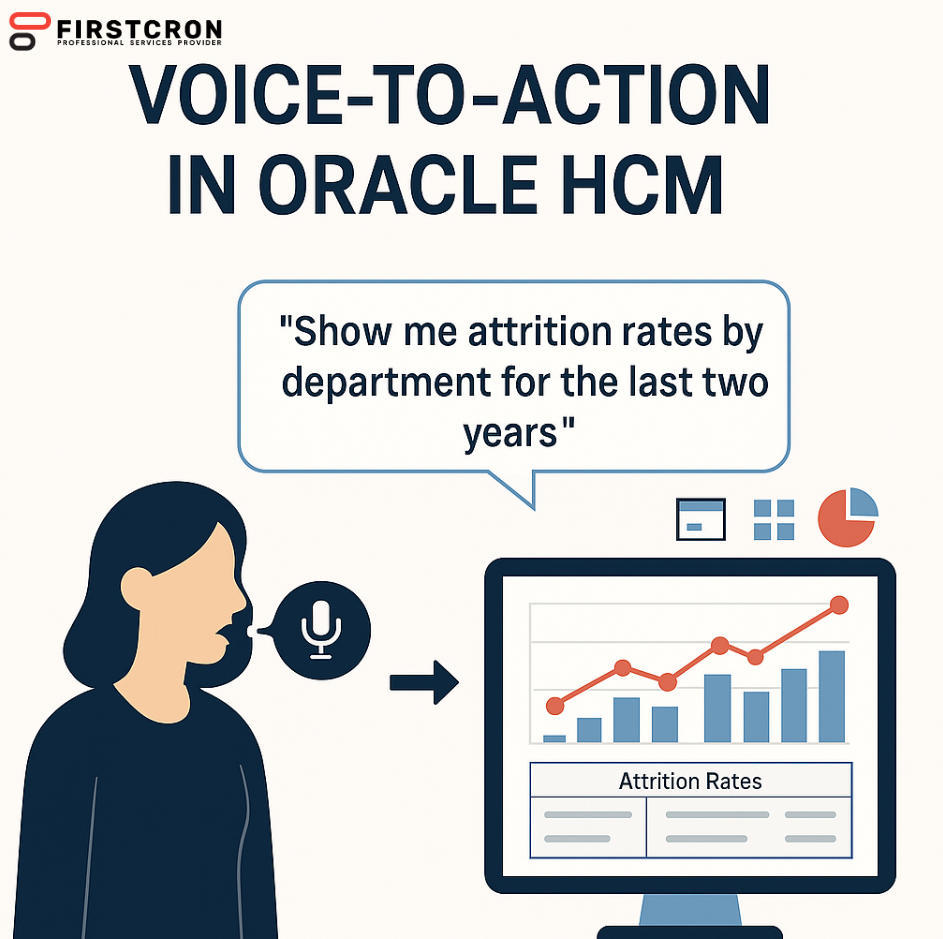
Voice-to-Action In Oracle HCM: Transforming HR Queries Into Intelligent Actions With GenAI
September 5th, 2025 23 min read
Redwood Readiness Checklist
July 23rd, 2025 7 min read
Automating Payslip Anomaly Detection With Natural Language Insights In Oracle ERP For The Public Sector
August 27th, 2025 24 min read
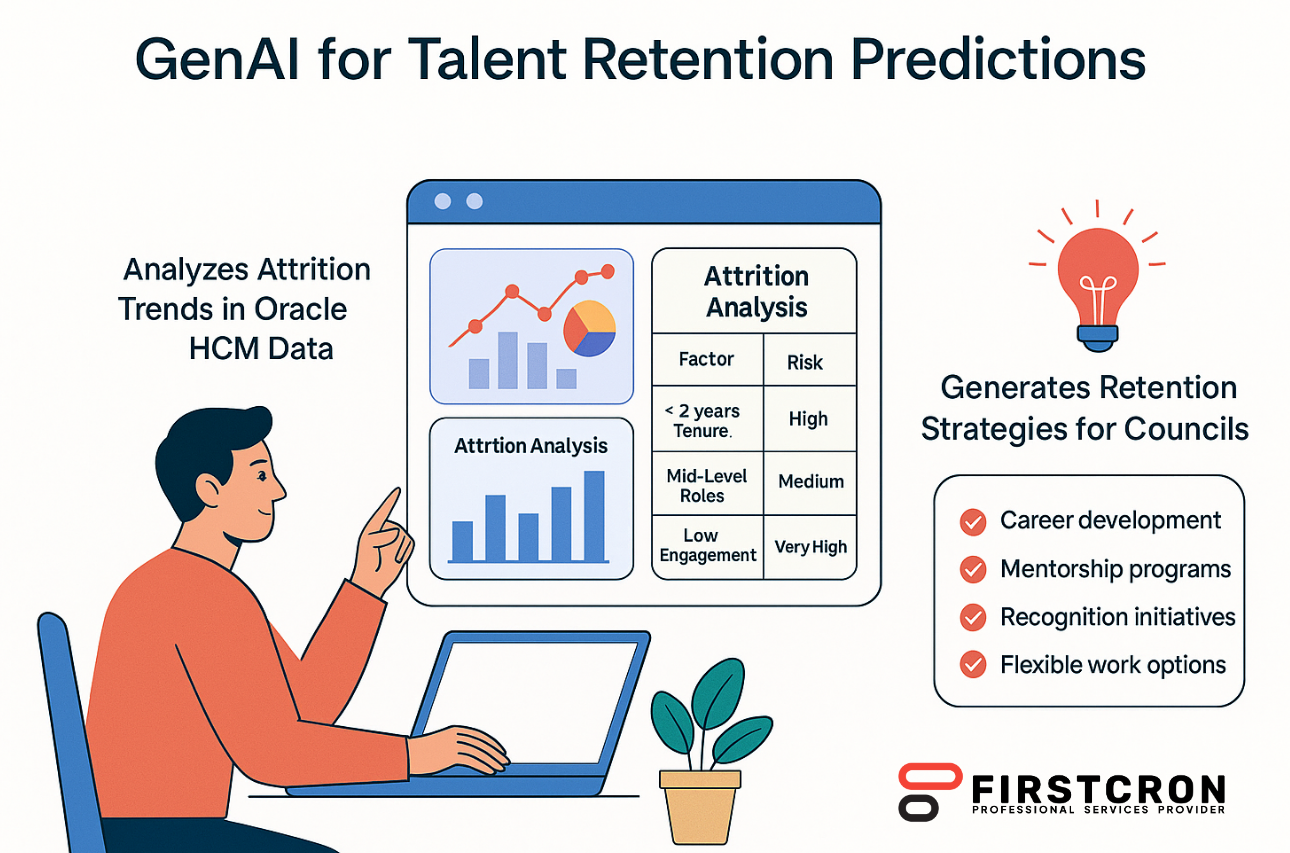
GenAI For Talent Retention Predictions: Unlocking Workforce Stability With Oracle HCM
September 4th, 2025 18 min read
FusionCheck: Your Smart Solution For Scalable Business Success
May 8th, 2025 9 min read