


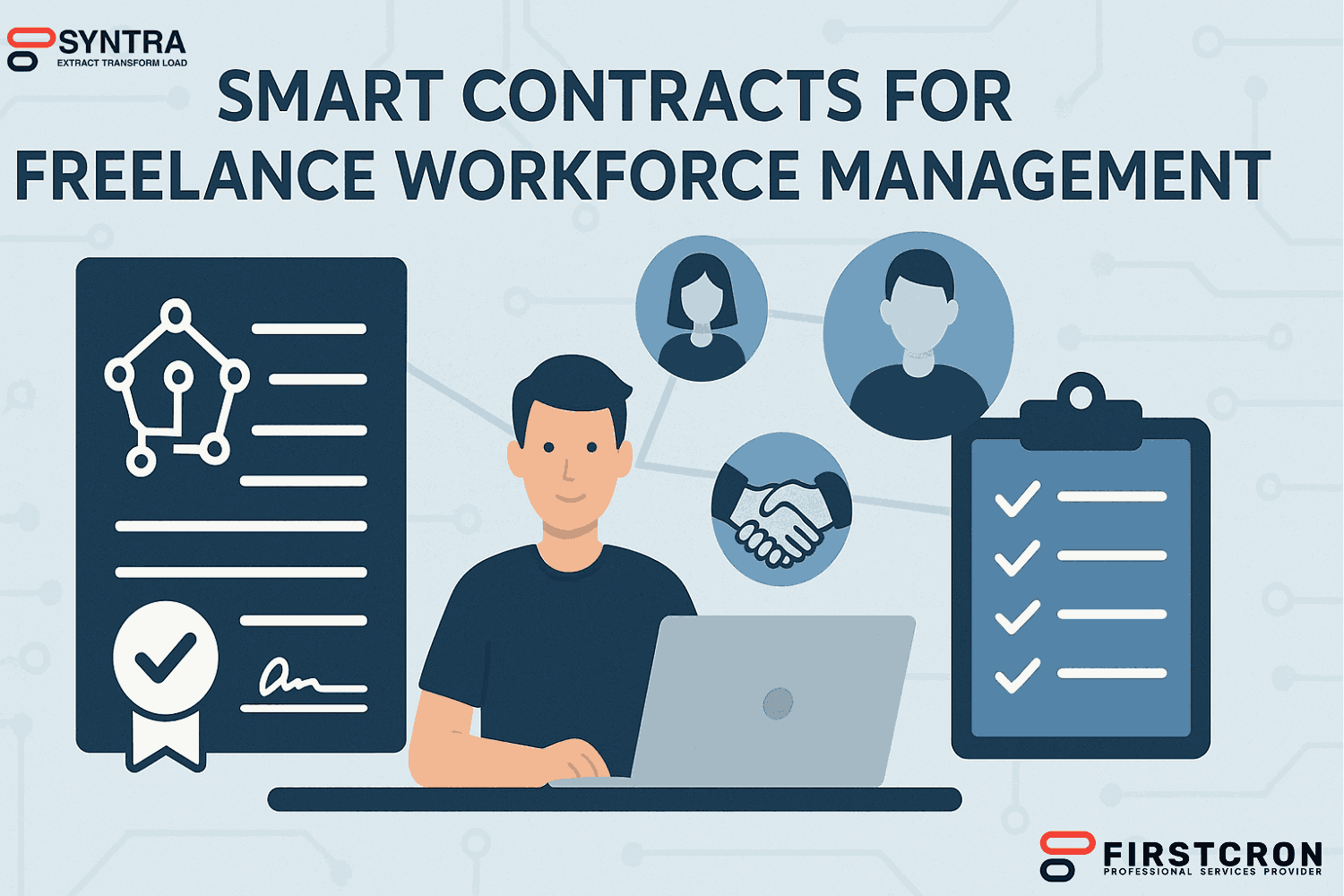
Freelancing has shifted from a niche corner of the labor market to a mainstream workforce model powering modern organizations. Businesses today depend heavily on remote, distributed, and project-based talent to scale quickly and stay competitive. However, this rapid growth has also exposed inefficiencies: delayed payments, manual approvals, inconsistent scopes of work, complex onboarding steps, and endless back-and-forth communication. These friction points slow down productivity and erode trust. This is where smart contracts enter the picture as a transformational solution.
In this blog we’ll cover
- Key Capabilities Of Smart Contracts In Freelance Management
- What Smart Contracts Really Are
- Why Smart Contracts Fit Freelance Workflows
- How Smart Contracts Operate In Real Scenarios
- Benefits For Organizations
- Benefits For Freelancers
- Impact On Global Distributed Teams
- Governance, Compliance, And Auditability
- The Future Of Freelance Management With Smart Contracts
Key Capabilities Of Smart Contracts In Freelance Management
- Automated milestone verification and payment release
- Escrow-backed financial security for both parties
- Immutable contract terms that reduce disputes
- Time-stamped proof of work and delivery logs
- Seamless integration with project management tools
What Smart Contracts Really Are
Smart contracts are self-executing digital agreements that run on a blockchain. They execute automatically when predetermined conditions—such as deliverable submissions or milestone completions—are met. Unlike traditional contracts that require human verification and manual processes, smart contracts enforce rules through code. This eliminates ambiguity and ensures that neither side can manipulate, delay, or bypass agreed terms. For freelance work, where engagements revolve around timelines, quality, and payments, this automation dramatically improves reliability and fairness.
Why Smart Contracts Fit Freelance Workflows
Freelance engagements rely heavily on clarity, timing, and transparency. A freelancer must trust they’ll be paid fairly and on time. A company must trust the work will be completed as agreed. Smart contracts shift this trust away from individuals and place it into the system itself. No more waiting for manual approvals, chasing invoices, debating scope changes, or worrying about nonpayment. Smart contracts enforce the rules impartially. Freelancers get paid when they deliver. Businesses pay only when the conditions are met.
How Smart Contracts Operate In Real Scenarios
Smart contracts function like automated project managers. Once an agreement is deployed, the contract continuously monitors triggers: “Has the work been submitted?” “Has it passed review?” “Has a milestone been met?” When the answer is yes, the contract automatically triggers the next step—most commonly the release of payment. This removes friction, speeds up cycles, and builds confidence on both sides. The blockchain records every action in real time, creating an audit trail that no one can manipulate.
Benefits For Organizations
Organizations gain tremendous advantages by applying smart contracts to freelance workflows. First, they reduce administrative burden—no more chasing invoices, monitoring milestones manually, or handling repeated follow-ups. Smart contracts automate these tasks, freeing HR, finance, and project teams to focus on higher-value work. They also reduce compliance risks by providing transparent audit trails. Additionally, companies can scale freelance engagements globally without worrying about timezone mismatches, procedural variation, or manual bottlenecks.
Benefits For Freelancers
For freelancers, smart contracts restore trust and stability in a system where delays and inconsistencies are common. Payments are guaranteed to be released automatically upon completion of work, eliminating the fear of nonpayment or unfair disputes. Scope clarity is maintained because terms are locked on the blockchain and cannot be altered after agreement. Freelancers also gain a permanent, verifiable record of work delivered, which becomes valuable for future engagements and reputation building.
Impact On Global Distributed Teams
As companies increasingly hire international freelancers, traditional payment systems often slow down collaboration. Cross-border payments can be expensive and take days to settle. Smart contracts simplify this by using decentralized settlement mechanisms that are faster and more cost-efficient. This allows projects to progress smoothly regardless of geography, enabling organizations to tap into a truly global talent pool while maintaining transparency and fairness.
Governance, Compliance, And Auditability
Smart contracts naturally support governance. Every action—deliverable upload, review timestamp, payment trigger—is recorded immutably. This ensures transparency for both the company and the freelancer. Disputes shrink dramatically because evidence is objective and blockchain-verified. For enterprises concerned with regulatory or operational compliance, smart contracts offer a reliable way to audit freelance work without additional administrative overhead.
The Future Of Freelance Management With Smart Contracts
As freelancing continues to expand, manual processes and trust-based workflows will no longer be sustainable at scale. Smart contracts introduce a standard of fairness, automation, and transparency that traditional systems cannot match. They minimize human error, reduce operational friction, and make freelance work predictable. For freelancers, they eliminate uncertainty. For businesses, they accelerate delivery and strengthen governance. Smart contracts represent the next evolution of freelance workforce management—efficient, secure, and built for the future.
Tags
Related Post
Navigating Oracle Fusion HCM & Payroll Patch 25C: Key Issues And Solutions For UK Local Councils
July 26th, 2025 10 min read
Learning And Talent Management With Cornerstone OnDemand
October 10th, 2025 17 min read
7 Proven Oracle Fusion Testing Principles To Guarantee Defect-Free Cloud Deployments
May 16th, 2025 15 min read
7 Reasons Why Companies Are Moving From Taleo To Oracle Recruiting Cloud
June 2nd, 2025 14 min read
Navigating Oracle Fusion HCM & Payroll Patch 25A: Key Considerations For UK Local Councils
July 27th, 2025 10 min read
WEEKEND READS
Navigating Oracle Fusion HCM & Payroll Patch 25C: Key Issues And Solutions For UK Local Councils
July 26th, 2025 10 min read
7 Proven Oracle Fusion Testing Principles To Guarantee Defect-Free Cloud Deployments
May 16th, 2025 15 min read
7 Reasons Why Companies Are Moving From Taleo To Oracle Recruiting Cloud
June 2nd, 2025 14 min read
Navigating Oracle Fusion HCM & Payroll Patch 25A: Key Considerations For UK Local Councils
July 27th, 2025 10 min read
UKG (Ultimate/Kronos) — USA And Global, Legacy-to-Modern Workforce Management
October 5th, 2025 23 min read
Driving Compliance And Security With Smart Testing In Oracle Fusion
June 5th, 2025 9 min read
How End-to-End Testing Of Oracle Fusion Enhances Operational Efficiency In Banking
May 23rd, 2025 11 min read
Data Migration Best Practices: From Taleo To Oracle Recruiting Cloud
May 28th, 2025 13 min read
Smart Onboarding Journeys With AI: Personalized Employee Integration Through Oracle HCM Core And Learning
September 13th, 2025 21 min read