


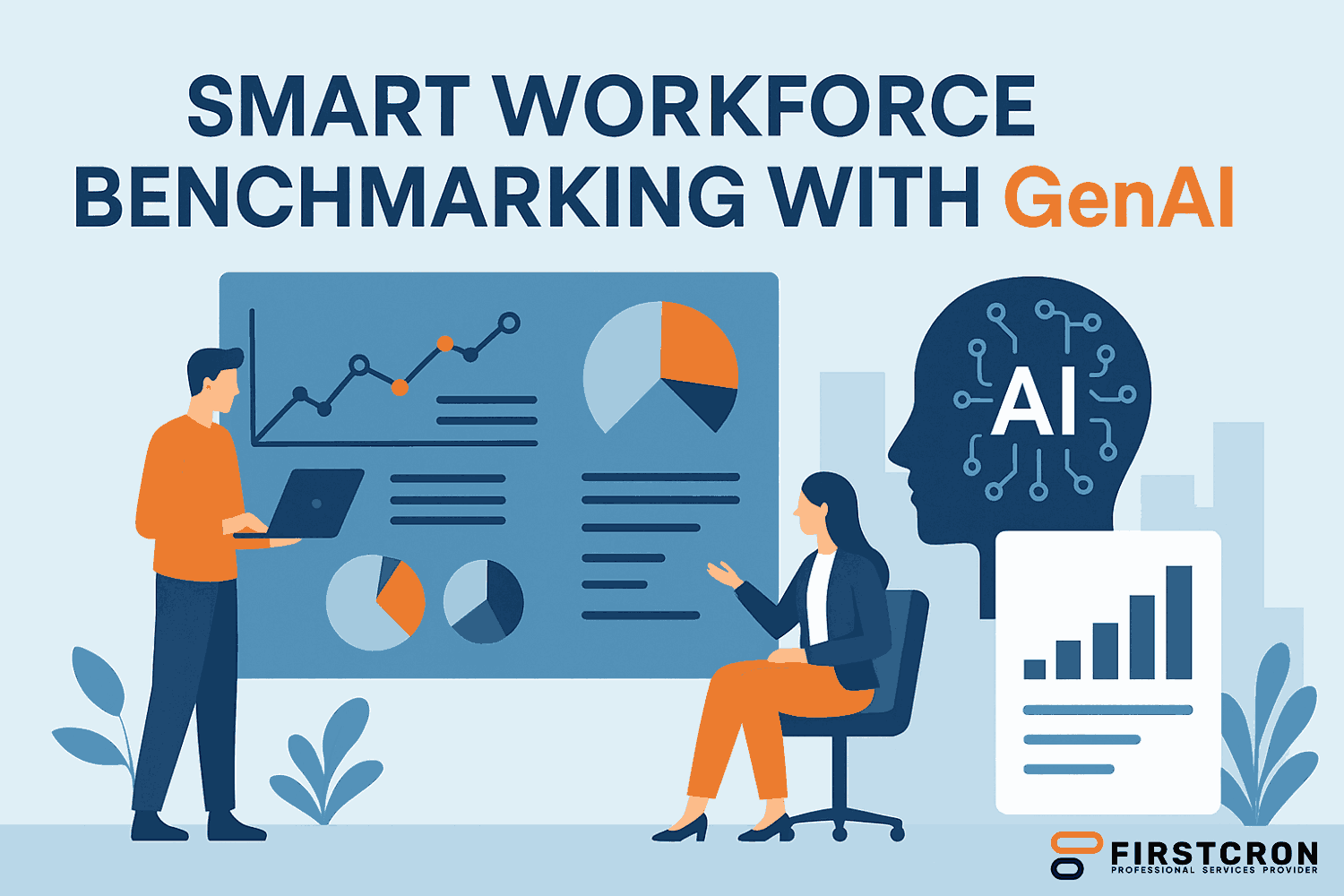
Workforce benchmarking has always been a strategic tool for organizations, especially councils and public institutions that must balance efficiency, compliance, and community service. Traditionally, benchmarking meant gathering workforce data, comparing it against industry averages or regional standards, and then interpreting what the variances meant. While this process provided valuable insights, it was often slow, resource-intensive, and heavily reliant on manual interpretation. The arrival of Artificial Intelligence, particularly Generative AI (GenAI), is revolutionizing this process. Councils can now leverage AI to compare workforce metrics quickly, uncover hidden patterns, and generate plain-language explanations that make benchmarking both accessible and actionable.
In this blog we’ll cover
- Why Workforce Benchmarking Matters
- The Role Of Generative AI In Workforce Benchmarking
- Addressing The Traditional Challenges Of Benchmarking
- From Data Overload To Actionable Insights
- Enhancing Comparisons Across Councils And Industries
- The Human-Centric Side Of AI Benchmarking
- How GenAI Improves Decision-Making
- Key Benefits Of GenAI-Driven Workforce Benchmarking
- Building A Culture Of Continuous Improvement
- A Case For Regional Adaptation
- Impact On Policy And Governance
- Future Directions: From Benchmarking To Strategic Foresight
- Overcoming Challenges In Adoption
- Conclusion: A Smarter Future For Workforce Comparisons
Why Workforce Benchmarking Matters
Benchmarking is not merely about comparing numbers. For councils, it reflects accountability to stakeholders, transparency in governance, and effectiveness in service delivery. Workforce data—ranging from headcount, skill levels, diversity metrics, absenteeism, to overtime—tells a story about how well a council is functioning compared to others. Without benchmarking, councils risk inefficiencies, outdated practices, and misalignment with the expectations of residents. However, the challenge lies in the overwhelming complexity of data sources and the difficulty of aligning metrics across different regions or industries. This is where GenAI offers transformative capabilities.
The Role Of Generative AI In Workforce Benchmarking
Generative AI does not just process data; it interprets and narrates it. Instead of providing raw figures, GenAI analyzes workforce metrics and explains what they mean in context. For example, if absenteeism rates in a council are higher than regional standards, GenAI can explain whether the variance stems from seasonal illness, policy differences, or structural workforce gaps. By generating plain-language insights, GenAI empowers councils to understand not only “what” the numbers are but also “why” they matter. This shift transforms benchmarking from a statistical exercise into a decision-making powerhouse.
Addressing The Traditional Challenges Of Benchmarking
Traditional benchmarking presents several hurdles: inconsistent data quality, lack of standardized metrics, and the sheer manual effort required to make meaningful comparisons. Councils often struggle to contextualize their workforce performance because external benchmarks vary significantly across regions. Furthermore, translating findings into actionable strategies takes time and expertise. GenAI reduces these pain points by harmonizing data from diverse sources, applying intelligent algorithms to ensure comparability, and instantly generating narrative explanations that make sense to managers, employees, and policymakers alike.
From Data Overload To Actionable Insights
Workforce data is vast. Employee demographics, turnover, training, engagement, salaries, and productivity indicators all contribute to the bigger picture. Without AI, councils drown in spreadsheets that overwhelm rather than enlighten. With GenAI, the process changes dramatically. Data is not only aggregated but also contextualized. Instead of presenting dozens of metrics, AI highlights the most important ones and explains their implications. For instance, “Your turnover rate is 12% higher than the regional average, primarily driven by younger employees leaving within two years of service.” Such clarity drives direct action, such as improving early-career engagement programs.
Enhancing Comparisons Across Councils And Industries
Councils do not operate in isolation. Their effectiveness can be measured against other councils, regional bodies, and even private sector standards for certain functions such as finance, HR, or customer service. GenAI enables dynamic benchmarking across these categories. It might reveal, for example, that while a council’s administrative costs are aligned with other councils, they are significantly higher than industry standards for similar services. This dual lens—public sector versus industry—enables councils to spot areas of excellence and areas needing urgent reform.
The Human-Centric Side Of AI Benchmarking
Numbers alone do not change behavior—stories do. Employees, managers, and community stakeholders must understand workforce insights in a way that resonates with them. GenAI generates narratives that make benchmarking outcomes relatable. Instead of abstract phrases like “efficiency index deviation,” the system explains, “Your department processes 20% fewer cases per employee compared to similar councils, largely due to reliance on manual reporting.” Such insights help leaders communicate issues effectively and inspire teams to embrace change rather than resist it.
How GenAI Improves Decision-Making
Workforce benchmarking with GenAI is not just retrospective; it is predictive. AI models can forecast how certain decisions will impact future benchmarks. If a council decides to reduce overtime allowances, GenAI can simulate the effect on workforce costs, employee morale, and regional competitiveness. These predictive capabilities transform decision-making from reactive to proactive, helping councils plan strategically rather than just responding to past data.
Key Benefits Of GenAI-Driven Workforce Benchmarking
The benefits of GenAI are not confined to automation—they extend to quality, speed, and inclusivity of insights. Below is a focused list that captures the unique value of AI-driven benchmarking for councils:
- Faster insights: Reports that once took weeks can now be generated in minutes.
- Narrative clarity: Plain-language explanations replace cryptic data points.
- Improved comparability: AI ensures metrics align across industries and regions.
- Predictive analysis: Councils can simulate policy impacts before implementation.
- Greater transparency: Stakeholders understand findings without needing technical expertise.
- Employee trust: Clear explanations reduce skepticism around workforce evaluations.
This combination of benefits ensures that councils are not only keeping pace with industry standards but also fostering an environment of trust, accountability, and informed decision-making.
Building A Culture Of Continuous Improvement
Benchmarking is often treated as a periodic exercise—done annually or quarterly. But with GenAI, benchmarking becomes continuous. Councils can receive real-time updates on workforce metrics and how they stack up against benchmarks. This allows organizations to course-correct quickly rather than waiting months to address inefficiencies. For employees, continuous benchmarking provides a culture of growth, where improvements are monitored, celebrated, and encouraged consistently rather than sporadically.
A Case For Regional Adaptation
One of the most valuable features of GenAI benchmarking is its ability to adapt insights to specific regional contexts. A workforce variance in a rural council may have very different causes than the same variance in an urban one. GenAI accounts for these nuances, generating explanations that consider factors such as population density, labor availability, or socioeconomic conditions. This regional adaptation ensures that councils are not unfairly penalized in comparisons and that solutions are grounded in realistic contexts.
Impact On Policy And Governance
Beyond internal workforce management, benchmarking insights have direct implications for governance and policymaking. Councils often justify budgets, resource allocation, or new initiatives based on workforce efficiency. With GenAI-driven benchmarking, policymakers gain robust, transparent evidence to support their decisions. For example, a council may use GenAI insights to argue for additional funding in areas where workforce metrics show significant regional disadvantages. This evidence-based governance builds trust with citizens and enhances accountability in public administration.
Future Directions: From Benchmarking To Strategic Foresight
The next frontier for workforce benchmarking lies in integrating it with broader strategic foresight. GenAI could eventually analyze not only current workforce metrics but also external trends—such as demographic shifts, technological adoption, or economic forecasts. By blending internal and external insights, councils could anticipate how their workforce will need to evolve over the next decade. For instance, if AI adoption across industries is projected to grow, councils could benchmark their own digital skill readiness against industry trends and prepare accordingly.
Overcoming Challenges In Adoption
Despite its potential, adopting GenAI for workforce benchmarking is not without challenges. Councils must navigate data privacy concerns, especially when handling employee information. They must also invest in the right infrastructure to integrate AI into existing HR and payroll systems. Change management is another hurdle, as staff need training to interpret and trust AI-generated insights. Finally, councils must establish ethical guidelines to ensure benchmarking does not unintentionally create bias or disadvantage certain employee groups. Addressing these challenges requires strong leadership, transparent policies, and a commitment to responsible AI use.
Conclusion: A Smarter Future For Workforce Comparisons
Smart workforce benchmarking with GenAI represents a transformative leap for councils. It takes a process that was once data-heavy, slow, and difficult to interpret, and turns it into a dynamic, narrative-driven, and predictive tool. By comparing workforce metrics against industry or regional standards, councils gain not only faster insights but also deeper understanding and foresight. The value extends beyond operational efficiency; it fosters transparency, accountability, and employee trust. As councils adopt this technology, benchmarking will no longer be seen as a bureaucratic necessity but as a strategic compass guiding workforce decisions in an increasingly complex world.
Please visit firstcron.com to explore more.
Tags
Related Post
Navigating Oracle Fusion HCM & Payroll Patch 25C: Key Issues And Solutions For UK Local Councils
July 26th, 2025 10 min read
Learning And Talent Management With Cornerstone OnDemand
October 10th, 2025 17 min read
7 Proven Oracle Fusion Testing Principles To Guarantee Defect-Free Cloud Deployments
May 16th, 2025 15 min read
7 Reasons Why Companies Are Moving From Taleo To Oracle Recruiting Cloud
June 2nd, 2025 14 min read
Navigating Oracle Fusion HCM & Payroll Patch 25A: Key Considerations For UK Local Councils
July 27th, 2025 10 min read
WEEKEND READS
Navigating Oracle Fusion HCM & Payroll Patch 25C: Key Issues And Solutions For UK Local Councils
July 26th, 2025 10 min read
7 Proven Oracle Fusion Testing Principles To Guarantee Defect-Free Cloud Deployments
May 16th, 2025 15 min read
Navigating Oracle Fusion HCM & Payroll Patch 25A: Key Considerations For UK Local Councils
July 27th, 2025 10 min read
UKG (Ultimate/Kronos) — USA And Global, Legacy-to-Modern Workforce Management
October 5th, 2025 23 min read

Driving Compliance And Security With Smart Testing In Oracle Fusion
June 5th, 2025 9 min read
5 Business Benefits Of Investing In AI-Powered Performance Oracle Fusion Testing
May 5th, 2025 11 min read
How End-to-End Testing Of Oracle Fusion Enhances Operational Efficiency In Banking
May 23rd, 2025 11 min read
Smart Onboarding Journeys With AI: Personalized Employee Integration Through Oracle HCM Core And Learning
September 13th, 2025 21 min read
Future Proofing Enterprise Testing: The Role Of AI Driven Automation In Oracle Fusion
June 26th, 2025 7 min read